



The Spirit of Independence Boosts Crop Productivity with Coin 45 Boron Fertilizer
Share:
About Article
SGI Friends, we all know that the month of August always holds special significance for Indonesia. The red-and-white flag once again adorns the streets, homes, and even the remotest villages. Various competitions are held, the spirit of mutual cooperation grows stronger, and we once again commemorate the struggles of our forebears in winning independence with the Spirit of ’45.
However, for Indonesian farmers, the spirit of independence can also be embodied through something deeply rooted in their daily lives: the ongoing struggle to produce healthy, productive, and high-quality crops. Independence Month can also serve as a moment to reaffirm the Spirit of ’45 by preserving farmland, tending to crops, and producing high-quality food. Agricultural productivity doesn’t come from a single action, but from a series of properly executed management practices from seed selection, land preparation, fertilization, and irrigation, all the way to pest and disease control. Amid the spirit of August 17, keeping crops healthy is a crucial part of maintaining agricultural productivity, friends. One aspect that must not be overlooked is the need for micronutrients. Although required in smaller amounts than macronutrients, micronutrients still play a vital role in plant growth and development. One such product is Coin 45 fertilizer.
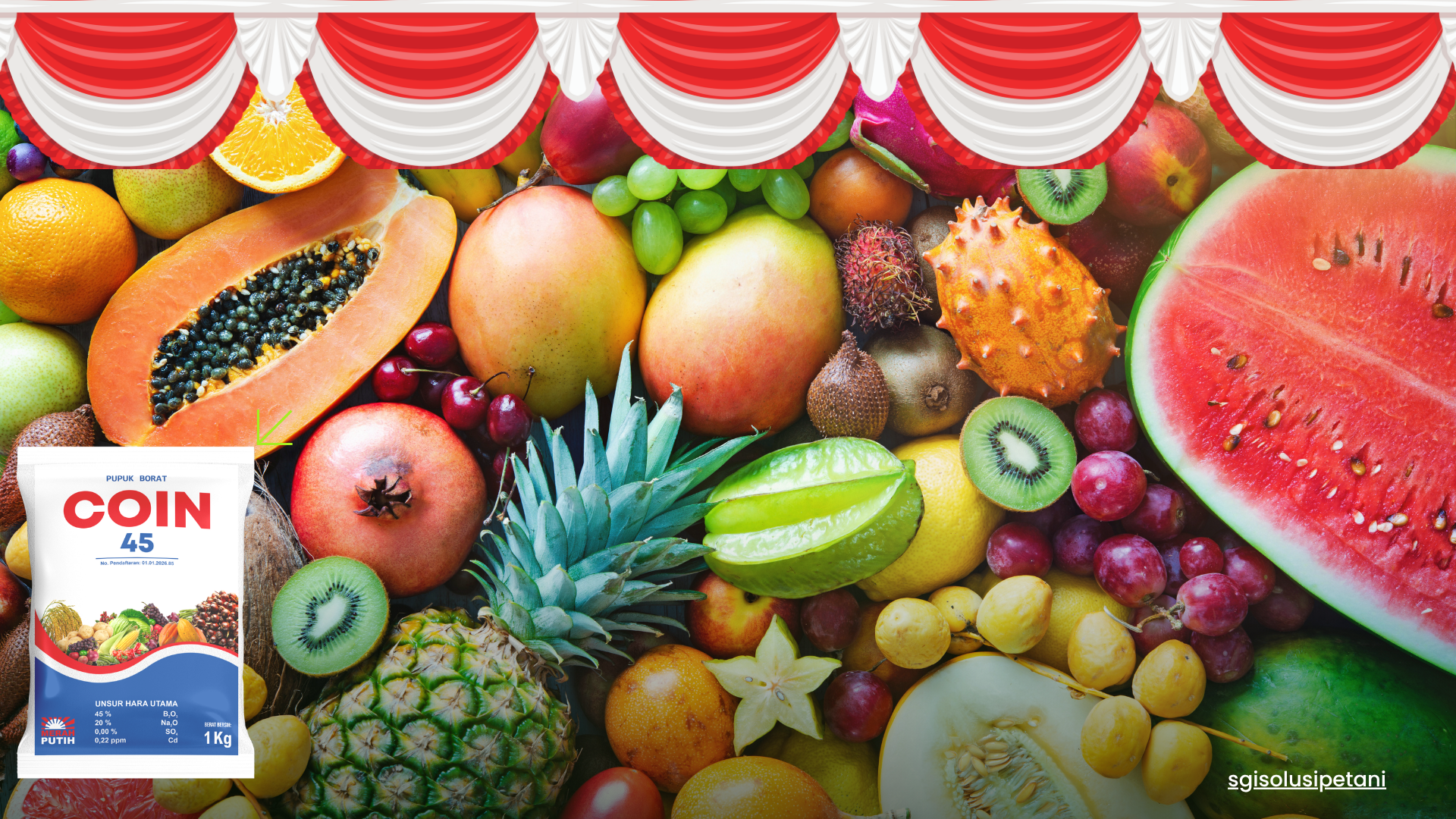
Coin 45 Boron Micronutrient Fertilizer is one of the product options available to help meet plants’ boron requirements. This product comes in the form of fine white granules that dissolve easily in water to help maximize crop yield. According to the product information, Coin 45 contains boron trioxide and sodium oxide, with the primary nutrients listed on the packaging at 45 percent and 20 percent, respectively. Use should always follow the instructions on the product label and take into account the condition of the plants and soil.
Independence Starts with Plants That Can Grow Optimally
In crop cultivation, macronutrients such as nitrogen, phosphorus, and potassium are often the primary focus. However, plants also require micronutrients in smaller amounts to support various growth processes.
One of these is boron. Although required in relatively small amounts, an adequate supply of micronutrients remains a crucial part of balanced plant nutrition management. This is because optimal agricultural yields are not simply about applying as much fertilizer as possible, but rather about providing the right nutrients according to the plants’ needs. The spirit behind this is not much different from that of independence. Progress is born when every element can fulfill its role effectively.
Why Is Fertilization Important for Agricultural Productivity?
Plants need nutrients to carry out various life processes. These nutrients support the growth of roots, stems, leaves, and flowers, as well as crop formation. Because the needs of each plant and soil conditions vary, fertilization should not be done merely based on habit. A more appropriate principle is balanced fertilization, which involves providing nutrients according to the plants’ needs, soil conditions, and production targets.
The Ministry of Agriculture, through a publication on plant nutrient sources, explains that balanced fertilization is one of the key production factors. In that publication, balanced fertilization is cited as contributing approximately 25 to 40 percent to production success. This means that nutrient management is a vital part of crop cultivation that cannot be separated from other production factors.
Data from the Central Statistics Agency also show that horticulture is a subsector that is continuously tracked and monitored through data on production, harvested area, the number of productive plants, consumption, and trade. The 2025 Horticulture Statistics contain data for 18 strategic horticultural commodities in Indonesia. This data indicates that crop productivity is a vital component of the national agricultural sector’s overall picture.
Understanding Boron as a Micronutrient
Boron is a micronutrient that plants require in small amounts but which plays a vital role. Boron is involved in cell wall development, tissue growth, carbohydrate metabolism, pollen development, fruit formation, and seed production. Boron deficiency can be observed in growth points, flower development, and fruit formation.
In fruit crops, boron’s role is particularly noteworthy because it is involved in flowering and fruit set. A resource from the Training Institute Education Center at West Virginia University explains that boron plays a role in pollen tube growth and fruit set in grapevines. Boron deficiency can disrupt pollination and cause young fruit to drop prematurely.
However, when it comes to boron, more is not necessarily better. Excess boron can also cause plant toxicity. According to the Chemical Abstracts Service (CAS) and Group III B under the old nomenclature of the International Union of Pure and Applied Chemistry (IUPAC), boron is an essential element, but levels that are too high can cause plant damage. Therefore, dosage and application methods must be based on the plants’ needs and the product’s instructions for use.
Boron Coin 45 Micronutrient Fertilizer is a fertilizer containing micronutrients in the form of fine, white granules that dissolve easily in water. This product can serve as a source of micronutrients to support plant nutrition management.
The information on the packaging indicates that the active ingredients are boron trioxide and sodium oxide. The product is available in 1 kg packages. Listed benefits include promoting flower growth to support pollination, helping to maximize crop yield and quality, supporting soil fertility, and providing the boron required by plants. Boron fertilizer should be used as part of a balanced fertilization program. This means that Coin 45 does not replace all of a plant’s nutrient needs. Requirements for nitrogen, phosphorus, potassium, calcium, magnesium, sulfur, and other micronutrients must still be addressed according to the crop, soil conditions, and growth stage.
The Benefits of Coin 45 That SGI Friends Should Know
Supports flowering. Boron plays a role in flower development and plant reproduction. Adequate boron supply can help plants carry out these processes more effectively when there is a need for boron.
Supports yield formation. Boron is linked to pollen development, fruit formation, and seed production. Therefore, adequate boron levels must be ensured, especially in plants entering the generative phase.
Supports plant quality. Balanced nutrient management helps plants obtain the nutrients they need. The key is not to apply as much fertilizer as possible, but to ensure that the necessary nutrients are available in the appropriate amounts.
4 Principles of Independence That Can Be Applied to the Fields
The spirit of August 17 can also serve as a reminder that Indonesian agriculture must continue to evolve.
There are several principles of independence that are highly relevant to the world of agriculture.
Freedom from Improper Fertilization Practices. Crop cultivation should not simply follow the practices of the previous season. Applying fertilizer based on actual needs is a step toward more efficient farming.
Freedom to Understand Crops Better. Crops always give signs such as changes in leaf color, slowed growth, disrupted flowering, or uneven development. Farmers who regularly observe their crops are more likely to identify problems early on. This allows corrective actions to be taken before issues escalate.
Freedom to Maximize Crop Potential. Every variety has its own productivity potential. However, this potential can only be realized if various supporting factors are met such as water, sunlight, soil conditions, pest and disease control, and fertilization each of which plays a distinct role. This includes meeting micronutrient needs; for example, Boron Coin 45 Micronutrient Fertilizer can be part of that strategy.
Farming Independently and More Efficiently: Production costs are one of the main challenges in farming. Therefore, every input should be used with a clear purpose in mind. It is not enough to simply apply fertilizer. Farmers need to understand its composition, why crops need it, when to use it, and how to apply it. The more precisely inputs are used, the greater the chance that farming costs will be utilized effectively.
How to Determine the Right Fertilization
Understand the plants and their growth stages. A plant’s nutrient requirements are not always the same throughout the season. Plants in the vegetative stage require support for leaf, stem, and root growth, while the generative stage involves flowering, fruiting, and fruit development.
Pay attention to soil conditions. Soil analysis can help determine fertility levels and nutrient availability. For certain crops, tissue analysis can also be used to help assess nutrient status; we recommend conducting both soil and tissue tests to confirm boron deficiency, as its symptoms can resemble those of other nutrient deficiencies.
Use the recommended dosage. Boron has a relatively narrow range between sufficient and excessive levels. Therefore, SGI Friends should not arbitrarily increase the dosage in the hope of achieving higher crop yields. Proper fertilization is fertilization that meets the plants’ needs.

The Spirit of August 17 Begins with Productive Agriculture
Independence can also be interpreted as the spirit to continue growing and becoming self-reliant. In the agricultural sector, this spirit can be realized through more systematic management of farming operations. Healthy crops, the use of appropriate inputs, and good land management are all part of the effort to maintain productivity.
During the Independence Day celebrations in August, farmers can make crop care a tangible expression of that spirit. This includes ensuring water needs are met, keeping fields clean, applying balanced fertilizers, and effectively controlling plant pests. Every small action, when done consistently, can support crop yields.
For SGI Friends, the use of micronutrient fertilizers such as Coin 45 can be considered when crops need additional boron. Application must still be adjusted according to crop conditions, nutrient requirements, and product instructions. With this approach, fertilization becomes more than just a routine it becomes part of a more targeted cultivation strategy.
Plant Care Strategies Before and During the Growing Season
Monitor the plants regularly. Inspect the leaves, stems, roots, flowers, and fruit to detect changes early on.
Ensure balanced fertilization. Do not focus on just one nutrient. Nutrient requirements must be tailored to the plants and soil conditions.
Pay attention to the flowering phase. In fruit crops, this phase is critical because it relates to pollination and fruit set.
Maintain water availability. Water plays a role in various plant physiological processes and aids in the movement of nutrients.
Control plant pests. Use appropriate control methods and apply pesticides according to the label instructions and for the correct targets.
Evaluate the results. Compare the condition of the plants before and after the care program to determine which steps should be maintained or improved.
Independence Month Time for Crops to Step Up
Fertilization and crop protection are two complementary aspects. Crops that receive the nutrients they need still need to be protected from plant pests that can hinder growth and reduce yields.
Don’t Wait Until Plants Show Problems to Pay Attention to Nutrition. One common mistake in crop cultivation is waiting for symptoms to appear before evaluating fertilization. By the time plants show signs of stunted growth, some of their production potential may already have been compromised. Therefore, a better approach is to fertilize in a planned manner from selecting fertilizers and determining doses to timing applications and evaluating plant condition after application. Fertilization is not merely a routine task. It is an investment to help plants reach their full growth potential.
The spirit of independence can be realized through concrete steps to maintain agricultural productivity. One such step is paying attention to plants’ nutrient needs through balanced fertilization. Boron is a micronutrient required in small amounts but plays a role in tissue growth, flower development, pollen formation, fruit set, and seed production.

Boron Coin 45 Micronutrient Fertilizer can be one option to help provide boron to plants as needed. Product information indicates its use on apples, grapes, and cocoa at different doses. Application must follow the instructions on the label and take into account the condition of the plants and the soil.
Keep in mind that no single product is the sole determinant of a successful harvest. Productivity is influenced by many factors, including variety, soil conditions, water, fertilization, pest control, weather, and crop management. Therefore, Coin 45 should be incorporated as part of a comprehensive crop care program.
PT Sinar General Industries is committed to providing solutions for farmers by offering high-quality products that support plant growth and boost agricultural productivity.
If you need information about high-quality fertilizer and pesticide solutions for various types of crops, please consult with us regarding your agricultural needs. Visit https://pt-sgi.com/ to access product information, consultation services, and agricultural solutions tailored to your farming business needs.
Important Facts About Boron and Crop Productivity
Coin 45 Boron Micronutrient Fertilizer is indeed needed in small amounts, but its role cannot be overlooked. Plants deficient in boron may experience problems with growth points, flower development, and fruit formation. Symptoms of boron deficiency typically appear on new growth and growing points, including stunted or rosette-shaped growth, dieback or distortion of shoot tips, brittle or thickened leaves, and reduced flowering or poor fruit set. Stems and petioles may crack or become hollow in some crops, particularly brassicas such as broccoli and cauliflower. Boron deficiency can be mistaken for calcium deficiency, which also affects growing points and new leaves, or zinc deficiency, which can cause shortened stem nodes and distorted young leaves. This information is important for SGI Friends because fertilization should not be based solely on guesswork. If plants appear unhealthy, the first step is to observe the pattern of symptoms and environmental conditions. Also consider the fertilization history, soil pH, water availability, and the possibility of pest infestations. With more complete information, fertilization decisions can be made more accurately.
This principle aligns with balanced fertilization. SGI Friends should not view boron fertilizer as a substitute for primary fertilizers. Boron functions as one of the micronutrients that complements plants’ nutritional needs. Fertilization programs must still take into account macronutrients and secondary nutrients as needed. The Ministry of Agriculture also emphasizes that balanced fertilization should be carried out by considering nutrient availability, soil fertility, plant needs, and production targets.
Building a More Planned Crop Cultivation System During Independence Month
August can be the perfect time to evaluate current farming practices. The spirit of independence is not only embodied through celebrations but also through the willingness to improve work methods. In farming, improvements can start with simple steps such as creating a fertilization schedule, recording plant conditions, checking application equipment, and evaluating harvest yields.
Planning helps farmers avoid excessive use of inputs. Before applying fertilizer, first determine which crops will be fertilized, their growth stage, soil conditions, and the purpose of fertilization. If the goal of fertilization is to help meet boron requirements, use a boron-containing product as recommended. Do not increase the dose simply because you want faster growth.
Therefore, the use of Coin 45 can be integrated into a comprehensive crop management system. Start with observation, proceed to determine nutrient needs, apply the fertilizer according to instructions, and then monitor the crop’s response. This approach is safer and easier to evaluate than applying fertilizer without keeping records.
SGI friends should also remember that agricultural success isn’t measured solely by the quantity of the harvest. Crop quality, efficiency in the use of production inputs, soil health, and land sustainability are also integral parts of good farming practices. Balanced nutrient management can help guide fertilizer use to better meet the plants’ needs.
From Rice Fields to Orchards, Farmers Are Part of Indonesia’s Strength Indonesia’s Independence Day is not only celebrated in major cities. The spirit of the Red and White also thrives among the vast rice fields, chili farms, orange groves, and various agricultural lands from Sabang to Merauke. Some farmers set out before the sun has even risen. Others continue to work in the fields despite unpredictable weather. Some are constantly learning how to combat pest and disease outbreaks. Others experiment with various technologies and cultivation methods to improve their harvests. Every crop that grows from Indonesia’s soil is part of the long journey to ensure the nation’s food security. Therefore, during this month of independence, it is only fitting that we express our appreciation to those who continue to keep the land productive. Indonesian farmers, keep growing alongside our nation.
Fertile soil is the cornerstone of successful farming. One way to maintain soil fertility is through balanced fertilizationthat is, applying nutrients according to the plants’ needs and soil conditions. Balanced fertilization not only helps plants grow optimally and increases crop yields but also maintains soil health in the long term. Using the right type of fertilizer, at the correct dosage, at the appropriate time, and applying it properly can improve fertilization efficiency while reducing negative impacts on the environment. Let’s practice balanced fertilization to support productive, efficient, and sustainable agriculture.
 17 October 2026
A Nozzle Is More Than Just the Tip of a Sprayer: Here’s How It Affects Spraying
Nozzles determine much more than just the direction of the spray. They also affect droplet size, flow rate, and spray pattern. Let’s take a...
 12 October 2026
Understanding Glyphosate A Systemic Herbicide for Weed Control
Glifosat dikenal sebagai herbisida sistemik non-selektif yang bekerja dari daun menuju titik tumbuh tanaman.
 05 August 2026
How to Choose the Right Pesticide to Effectively Control Plant Pests
Choosing the right pesticide is essential for effectively controlling plant pests. Let’s take a look at this comprehensive guide on types of...